 October 7, 2011
In West of Eden: The End of Innocence at Apple Computer, first published in 1989, Frank Rose tells the story of the fall of Steve Jobs at Apple. It begins with Jobs, then 27 and excited about the idea that Apple could sell computers as if they were packaged goods, recruiting Pepsi-Cola president John Sculley to run the company. It ends with three years later with Jobs stripped of any responsibility in the company and leaving to form NeXT. In between came the launch of Macintosh, a project Jobs had taken over when it became clear the board wouldn’t let him run the company himself, and the crisis that erupted when Mac sales failed to meet expectations and Sculley failed to do what Jobs thought necessary to save the company. With Jobs and Sculley increasingly at each others’ throats, a showdown was inevitable. At an executive staff meeting in the boardroom on the Friday before Memorial Day 1985, the inevitable happened.
IT WAS A NATTIER-THAN-USUAL Steve who bounced into the boardroom on Friday morning, a model young executive in a hand-tailored, gray-striped Wilkes-Bashford suit. The other executive staff members were already seated, and since Jay Elliot, the vice president of human resources, had taken Steve’s usual place to the right of John, Steve took a seat at the far end. They were meeting that morning to discuss what John would say to the two dozen middle managers who’d be gathering downstairs to hear a reassessment of their strategy. But the air of expectancy and dread that greeted Steve as he entered the room was caused by more than the fear that they were focusing on the wrong markets. After Thursday night’s phone calls, anything could happen. It didn’t take long to find out what.
John looked like a man who was trying to summon up his last iota of energy. Gone was the runner’s edge; in the past couple of weeks he’d turned into a sack of parsnips, thin, pale, and misshapen. But as Steve started to sit down, John looked at him head-on across the long expanse of polished hardwood and made an announcement that hit the other end like a bowling ball. He said he’d heard Steve was going behind his back to try to kick him out of the company.
Steve’s pupils narrowed to the size of pin pricks and honed in on John with a stare of laser-like intensity. That’s right, he said. John should leave. He didn’t know how to run the company. And while he was accusing Steve of sneaking around behind his back, he himself had gone to the board in April to have Steve removed as head of the Macintosh division. He was supposed to be Steve’s mentor, supposed to help him learn to manage a big organization, and instead he was trying to kick him out. He was a sleazeball.
John had to go, Steve said. They all agreed. John wasn’t providing leadership, the company was a wreck, they wanted him out.
God, John thought, what if he’s right?
John started to stammer, a childhood trait he thought he’d outgrown years ago. Slowly, shakily, he forced the words out. He hadn’t been able to help Steve because the company was in too much of a crisis. He’d tried to save their friendship, but now it wouldn’t work any longer. He couldn’t tolerate this. He couldn’t trust him.
John had to go, Steve repeated. He looked around the room. They all agreed, he went on. John wasn’t providing leadership, the company was a wreck, they wanted him out.
God, John thought, what if he’s right? He couldn’t go on without the others’ support. He’d have to see who they backed. So now, one by one, he called on them to declare their loyalties—starting with Del Yocam, general manager of the Apple II division, who was seated to John’s left.
Having no choice, Del plunged ahead unrehearsed. He loved Steve, he said, loved him for making them what they were today, and he wanted him to play an active role in the company. But he respected John for his experience and capability, and he’d support him in whatever decision he made.
Like Del, Al Eisenstat, the chief counsel, turned to Steve as he began to speak. He said he cared about Steve and John both and he wanted Steve’s contribution to the company, but he’d have to go along with whatever John’s decision was. Then he told Steve how sorry he was.
Across from Al was Bill Campbell, the chief coach of sales. He turned to Steve and spoke in a voice that almost quavered. He said he really wanted Steve to have a role. He said it would be a real shame, not just for John and Steve but for Apple, if the two of them didn’t work out their differences.
Next to Bill was Regis McKenna, Apple’s long-time PR consultant, who sat in on their meetings as an ex officio member. He’d told Steve before he couldn’t run the company, and he told him again now. He felt John had to be given the opportunity to run Apple, and he’d support him.
Dave Barram, the CFO they’d hired from Silicon Graphics, had been there less than two months; he echoed the others.
Jay Elliot spoke last. He thought they were both being self-indulgent with their little power struggle. They were too wrapped up in themselves to care about the five thousand people who worked for the company. It was ridiculous that they couldn’t work this thing out. He wouldn’t pledge his loyalty to either one of them; he was pledging it to Apple.
Steve sat listening with his head down. When the litany finally ended, he looked up and in a quiet voice, not quite tremulous, said he wasn’t sure what he was going to do. His face was a mask of utter devastation. There was no trace of the sparks he’d fired earlier; in their place was the uncomprehending stare of a little kid whose world has just been shattered. John, crumpled into his chair at the other end of the table, looked scarcely better. Bill and Jay pleaded with them to keep it together, to work it out, not to blow up Apple in their spat, but it was too late. Finally Jay reminded them that they had a lot of people downstairs and they had to tell them something.
Two floors below, 24 people from across the company were crowded into a long, narrow meeting room to hear John’s pronouncements on the crisis they were facing in the marketplace. Alan Kay was there, and Tom Marano, the sales director who’d just been hired from Pepsi, and Mike Lorellit, the marketing whiz from International Playtex who’d just been hired for the Apple II division. The audience seemed sorted by order of knowledge, with those least aware of the true crisis at the front of the room and those most aware in the rear, as far away as possible. The Macintosh staff was sitting at the very back, and when the exec staff members came down they sat alongside them. Steve came in last, looking like a dead man, and took the backmost seat of all, in a corner.
John made no mention of what had just happened upstairs. Instead he spoke in vague and general terms about Apple’s future and the hard times ahead. John had a mind like an outline processor, able to tick off points and sub-points and sub-sub-points for hours without recourse to notes, and as he addressed them in his dull, dry monotone, this outline processor clicked on. For an hour and a half he droned on about expense reduction and new products and accountability and communication. He sketched out seven goals and announced the creation of “study teams” to investigate their problems and come up with solutions. As he spoke, he moved more and more behind the pillar he was leaning against. Finally, almost hidden, he asked for questions.
Study teams. These were pirates, or had been, and now they were being asked to submit written reports in triplicate. They were taking the committee response. They wouldn’t have to meet the crisis; they could just study it to death. Bill and Del looked disgusted. Steve sat in the corner with his arms folded and his head down. Alan Kay asked why they didn’t give money to universities to fund basic research. Finally, without another word, everyone filed out.
AS SUNDAY TURNED INTO MONDAY and the long Memorial Day weekend waned, Steve continued to nurse the hope that things would somehow be made right — that John would still be fired, that John would step aside and let him run the company, at the very least that John would relent and put him in charge of product development. He had phoned Mike Markkula, Apple’s original angel investor, and tried to set up a meeting at Markkula’s ranch in Carmel Valley, just over the mountains from Big Sur. He wanted to come down with his staff and tell Markkula what was really wrong with Apple. Markkula hadn’t expressed much enthusiasm, but finally he agreed to meet with them on Monday morning at Steve’s house in Woodside.
Like everything else, the meeting with Markkula didn’t go the way Steve thought it would. Markkula set the ground rules. The main rule was, Steve couldn’t say anything. Markkula wanted to hear from Steve’s staff members directly; he didn’t want Steve prompting them.
It was chilly that evening, and there was a draft inside the echoing chambers of Steve’s empty San Simeon. The room was vast, close to 2,000 square feet, and bare except for a single Oriental carpet that covered a fraction of the floor. Markkula listened quietly as Steve’s four lieutenants gave their views of what had gone wrong, of how they’d come to be in this state, of what they could do to get out of it. There was no banter, no chit-chat, no comic relief.
Markkula said almost nothing. When it was all over, he stood up. The matter would be resolved soon, he said, and it wouldn’t be to everyone’s liking. Then he got in his car and drove off.
On Tuesday morning, John had breakfast with Steve and told him he didn’t think there’d be a role for him at Apple. Then he drove to Mike Markkula’s house in Portola Valley, a secluded enclave nestled in the hills above Stanford, to have his own audience with Markkula and seek his blessing for the step he was about to take.
John phoned Steve at home. It was official now: Steve was being removed as general manager of the Macintosh division, and he wouldn’t have any other operational role in the company. In a few minutes it was over.
Steve was right about one thing: Markkula’s was the vote to swing. As a co-founder and former president of the company he held an exalted status on the board; his was the voice of reason. And Steve, by so ineptly forcing the board to choose between John and himself, had in is desperation reduced the issue to a stark and simple choice. They could back John, who might be able to stanch the flow of red ink and lead them back to profitability; or they could back Steve, whose only visible talent was his ability to articulate a vision they’d never fully shared in the first place.
Hours later, John drove away with Markkula’s support. When he got back to his office, he polled the other board members on the phone and got their backing as well. The matter was settled. He was in command.
So on Tuesday evening, John phoned Steve at home. It was official now: Steve was being removed as general manager of the Macintosh division, and he wouldn’t be getting any other operational role in the company. In a few minutes it was over, and Steve was left with the realization that he’d lost—lost the company, lost his dream, lost his chance to change the world.
Over the next few hours, sobbing, he called around to say good-bye. He called Bill. He called Al. He called Mike Murray, the marketing chief of the Macintosh division. Choking back tears, he said he just wanted Mike to know that the past few years had been one of the best times of his life. He wanted to say good-bye. And then the phone clicked dead.
This guy sounds terrible, Mike thought. He decided he’d better see what was happening. He jumped in his car and raced up 280 to Steve’s house. The past three years spun willy-nilly through his mind and he drove, the whole incredible trip. He imagined finding Steve sprawled on the floor, a suicide. He’d have to call the police. Ambulances would come, and then the press. It would be all over the papers in the morning. What would the headlines say? How would Sculley feel? Couldn’t they have talked just one more time?
The hacienda was completely dark, its white walls gleaming in the moonlight. The front door was open. Mike dashed frantically through the empty rooms. He couldn’t find Steve anywhere. He sprinted up an outside stairway to Steve’s bedroom and knocked on the door. A light was on inside. “Steve?”
It was a spartan room, just a mattress and some blankets on the floor and a single light overhead. A metal break rack against one wall was stacked high with television and stereo equipment; clothes were piled on the floor. Steve was sprawled across the mattress. “Oh, hi,” he said as he looked up, his face bleary-eyed with tears. Mike lay down and put his arms around him, and they cried together. No, Steve assured him, he hadn’t been thinking about anything stupid. He’d just been wondering why it all had to be this way.
THREE WEEKS AFTER the boardroom confrontation that set the whole thing in motion, HR announced layoffs that totaled a fifth of the work force. Some 1,200 people lost their jobs, most of them factory workers. In Cupertino, nearly 250 people were let go. There were generous severance payments and special crisis centers in case anyone got distraught, but there was no arguing whether the cuts were needed. That same day, as laid-off engineers and marketing people were getting drunk at Eli McFly, the steampunk theme bar down the street, the public relations office announced that Apple would post the first quarterly loss in its history.
There was one problem no one knew how to deal with—not HR, not the exec staff, not John or the board. What were they going to do with Steve? As the chairman and largest stockholder, he hardly seemed in line for outplacement counseling; and yet they didn’t exactly want him around either.
Apple was his, Apple was all he’d ever known. He was still chairman of the board. But what was a chairman supposed to do?
That was the question John was wrestling with. According to the corporate by-laws, the sole function of the chairman of the board was to chair the board meetings. Since the board met only a few times a year, that would leave Steve with a great deal of time on his hands. He wanted to do something. But it was too late for that now. There was no role for him at Apple any more, and more than anything else it was the move that made that clear.
In the weeks that followed the layoffs, as the corporate reorganization took hold, nearly everyone at Apple was moved to a new location. As chairman of the board, Steve should have rated an office in the Pink Palace, as the headquarters building was known around Apple. He wanted the office he was supposed to have had when they moved into the building in 1983, directly opposite John’s on the third-floor executive suite. But John didn’t want him around. So he was moved to the annex to Bandley 4, a small white stucco building with a red tile roof across the street from what a few weeks before had been the Macintosh building. Aside from his secretary and the security guard, he was the only person in the building. He called it Siberia.
A week later, he filed papers with the Securities and Exchange Commission announcing his intention to sell a large chunk of his Apple stock—850,000 shares, worth about $14 million at current prices. There’d been reports he’d tried to stage a leveraged buyout, lining up backing from Morgan Stanley to borrow enough money to seize control of the company. The sale made it clear wasn’t contemplating an attack, but it didn’t leave Apple any more secure financially because the natural expectation was that he’d keep selling. The six million shares he had left would keep the stock price down like a rock, and that would leave them vulnerable to a takeover bid from some other quarter.
Steve was selling for the same reason many people sell their stock: He didn’t have any faith in the people who were running the company. First they’d sent him into exile, and now, despite Sculley’s initial statements that he would serve in some vaguely defined role as a corporate visionary, it was being made clear that his ideas were no more welcome than his presence was. A taste of the new order came when one of his former associates tried to find him in Siberia. She didn’t know where his new office was, so she went to the receptionist in Bandley 4 and asked. The response was crisp and to the point: “Steve Jobs doesn’t work here any more,” the receptionist informed her. Yes, she said, but he has an office here and I need to talk to him. At that point the receptionist echoed Sculley’s words to the stock analysts as if by rote: “Steve Jobs,” she said, firmly and with great finality, “does not have any operating responsibility in this company.”
The transition was being made.
In the second and final installment from West of Eden, Steve Jobs leaves Apple to found NeXT—and finds himself sued by Apple for breach of fiduciary duty.
October 9, 2011 | Second of two parts
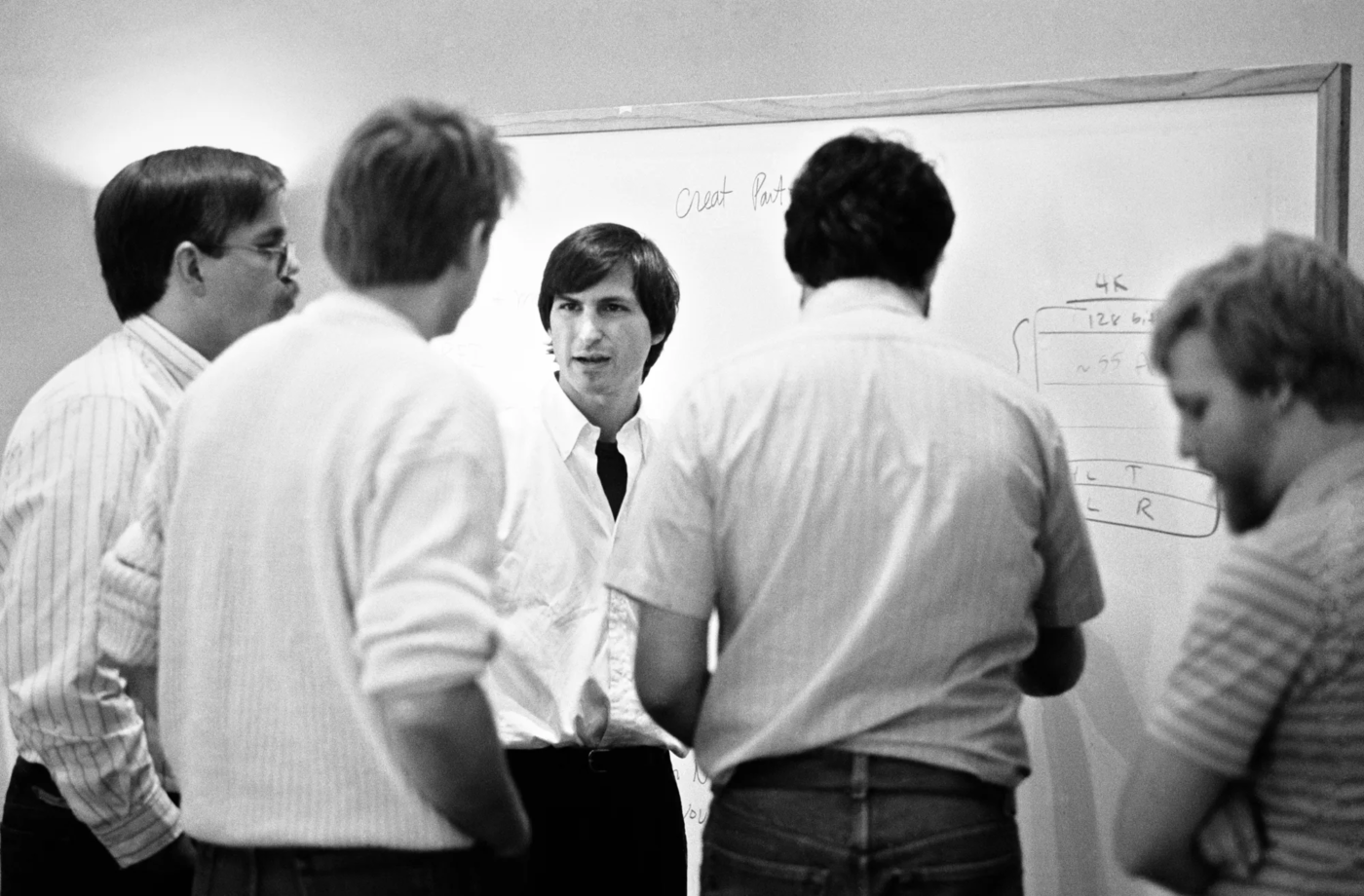
Steve Jobs takes the leadership role at NeXT. Photo: Doug Menuez
 In the previous excerpt from West of Eden — Frank Rose’s account of the three-year period at Apple that began with John Sculley’s recruitment as CEO and ended with Steve Jobs leaving to found NeXT — Jobs is removed from his position as head of the Macintosh division and installed in an otherwise empty office building he dubs “Siberia.” Though still chairman of the company he co-founded, he has been stripped of any role in running it. Now he has to decide what to do next.
STEVE DIDN’T SPEND MUCH TIME in Siberia. It was too depressing, and there was no reason for him to anyway. Instead he flew to Italy with his girlfriend. He wanted to wander the hill towns of Tuscany—timeworn villages like San Gimignano and Montepulciano, with their medieval towers and their Renaissance palazzi set amid vineyards and orange groves and straw-colored hills. It was a little like the San Francisco Peninsula, only with abbeys instead of shopping centers. After Tuscany there was Paris. Even in August, Paris was better than Cupertino. He began to think about not going back. He was young. He had money. Maybe he could become an expatriate.
But Steve’s expatriate phase didn’t last long; a week later, he was back in California. He still had no idea what to do next. For awhile he thought about politics. He had long fantasized about entering politics on the John Kennedy model, taking over the government, straightening out the bureaucracy. Some people saw in him the charisma, the larger-than-life quality of men like Kennedy and Reagan. It was too bad he had never registered to vote.
Then there was biology. The year before, at a lunch at Stanford, he had found himself seated next to Paul Berg, a Stanford biochemist and Nobel laureate. Steve came away from lunch with the impression that, in essence, life is soup. After countless millennia of inquiry, mankind was finally on the verge of discovering the secret of life, and what was it? A chemical stew in which information is encoded algorithmically, just as it is in computers. Biology and electronics were one—they just used a different encoding system. It was too much! So he called up Paul Berg and made a date for lunch. Maybe it was time to educate himself a bit.
They met at Stanford and talked about how biology works and how it might be simulated on a computer. When Steve asked why college professors didn’t run simulations of Berg’s experiments for their students, Berg told him most classrooms didn’t have computers powerful enough to do the job. Steve started thinking about what teachers might be able to do if they had the right tools—tools it apparently hadn’t even occurred to them to ask for.
After his return from Europe, Steve had started a list of the things he’d done over the past ten years that meant a lot to him. Three things began to pop out, each of them having to do with school. There was the Apple Education Foundation, which the company had set up to dispense grants of money and computers to schools and community groups. There was “Kids Can’t Wait,” which saw thousands of Apple IIs donated to California public schools in exchange for a tax write-off. And there was the Apple University Consortium, which made Macintosh available to colleges and universities at below-retail prices.
People were telling Steve they wanted out. They didn’t like what Apple was becoming and they did like working with Steve—the ideas, the excitement, the risk.
By this time, life for Steve had boiled down to a series of one-event days. He’d take an entire day to buy a new 35-millimeter camera. But lunch with Paul Berg helped crystallize a few ideas in his mind. He was beginning to think there was a need for a computer that would be powerful enough to simulate complex biochemistry experiments and yet inexpensive enough for colleges and college students to afford. Apple’s education efforts were staring out at him from the list he’d made. And the Macintosh crowd had been after him all summer to start a new venture.
People were telling him they wanted out—Bud Tribble, the original Macintosh software architect; Rich Page, a Mac hardware architect whose latest project at Apple had just been cancelled; George Crow, the engineer who’d made the Mac’s disk drive work; Susan Barnes, the Macintosh division’s controller. With Rich to design the digital boards, George to design the monitor and the power supply, Bud to do the software, and Susan to run finance, he’d have the nucleus of a computer company. All he lacked was marketing.
The obvious candidate for a company that would sell computers to universities was Dan’l Lewin, the young marketing guy who’d put together the University Consortium for Apple. Lewin knew the university market better than anyone. On the day after Labor Day, Steve picked up the phone and asked if he wanted to talk.
He called at a good moment. The University Consortium, while extremely profitable for Apple, had nearly been killed in the confusion of the June reorg because a lot of retailers—the lazy ones, Lewin thought—claimed it was taking business away from them. Lewin had helped fight that off, but he was frustrated by the consumer-goods management techniques—the secretiveness, the constant status worries—that had been introduced by Mike Lorelli, the new marketing director from Playtex. So he drove up to Steve’s house and they spent a couple of hours walking around the grounds. Dan’l thought his idea was interesting—extremely interesting. But he had some reservations, and he left without making any commitment.
The other four arrived for dinner a short while later—Bud, Rich, George, and Susan. They sat in the dining room and drank California wine and ate vegetarian pizza. Then Steve announced his plan: He was thinking of starting a new company that would make the next great computer for higher education. The others weren’t all convinced it would be successful, but they didn’t like what Apple was becoming and they did like working with Steve—the ideas, the excitement, the risk. It wasn’t long before they were talking about salaries and engineering features and what kind of company they wanted to build.
Steve called Dan’l a few days later to tell him he’d definitely be starting a new company. Dan’l was going to be traveling, but he promised to call Steve the following Tuesday night. The September board meeting was scheduled for Thursday evening, and Steve wanted to use the occasion to announce his plans.
SEPTEMBER WAS NOT a good time for Apple. The company was split down the middle on the Steve issue: Some people were glad to be rid of him, others were wearing T-shirts that read, We want our Jobs back. People at every level were nervous, insecure, fearful of the future. At the top there was a rudderless sensation. Even with Steve gone, Sculley seemed unable to give coherent direction to their efforts. Marketing programs were being blown, money was being wasted, and John just seemed to sit there as events swirled around him. They all seemed to be on their own. If the board didn’t intervene, the company might sink into oblivion. So the September board meeting came at a particularly awkward moment—dangerous for John, difficult for the executive staff, tricky for Steve, troublesome for the board.
The agenda consisted mainly of a series of presentations on the turnaround they’d accomplished since June. The board members seemed to greet them all coolly. The final item on the agenda was something labeled “chairman’s report.” Steve, speaking from a prepared script, quickly outlined his plans. Over the summer he’d thought about doing a number of things—going into politics, maybe going back to school, or starting a company of his own. He’d decided to do the last, and the company he wanted to start was one that would build computers for the higher-education market. He didn’t offer any details—at that point, he didn’t have any—but he did say that that his new venture would be complementary to Apple, not competitive with it. He added that he’d be taking a handful of people with him, and that he thought he should resign from Apple’s board.
Susan Barnes was the only one there who worked on the same floor as the exec staff. She knew those guys. They were paranoid about Steve and what he was going to do to Apple. They’d kill.
Once he’d finished, the board members asked him to leave the room while they discussed the matter. His plans sounded interesting, they agreed, and if the new venture really wasn’t going to compete with Apple, they might even want to invest in it. After half an hour of discussion, the invited Steve back and told him as much.
As soon as the meeting was over, Steve drove home to Woodside. It was early evening, and the other five—George, Rich, Susan, Bud, and Dan’l—were waiting at his house. There was a charge in the air, a tingle of apprehension and excitement. Joining him was an act of blind faith, like stepping over a cliff, for regardless of how they felt about Apple, there was no question that it offered more security than Steve could. They were starting out with no business plan or stock plan or company charter or product definition. But there was no turning back now.
Over a dinner of fresh pasta, they debated what they should do next. Both Steve and George were intrigued by the idea that Apple might invest in them. But Susan went crazy at the thought. She was the only one there who worked on the same floor as the exec staff. She knew those guys, and they weren’t going to sit still for this. They were paranoid about Steve and what he was going to do to Apple. They’d kill.
AT 7:30 THE NEXT MORNING—Friday, September 13—the executive staff convened in the boardroom to deal with issues from the board meeting. John took his place at the head of the table and, in matter-of-fact tones, gave the six exec staff members the news: Steve was leaving to form a new company that would be noncompetitive with Apple; the board was thinking of investing in it; and the following five people were leaving with him. He read off the names, and almost immediately the meeting dissolved into pandemonium and outrage. Steve was taking their head of software? He was taking their head of education marketing, who knew the field better than anyone else? Steve was going to destroy the company he’d built—and John and the board were going to let him do it?
The exec staff reached a consensus: What Steve had done was wrong, and John had to take action. Steve was viewed as some kind of messiah at Apple, and they needed to expose him for the fraud he really was.
John and Al Eisenstat, the company counsel, looked nonplussed, as if they didn’t quite see the problem. The outburst swirled around them regardless. How could Steve do this to Apple? How could John and the board be so naïve? How could any of them say this new company would be noncompetitive? John sat slouched in his chair, biting his nails and fixing one or another of them with his cold, penetrating stare. Finally he went to his office and tried to get a couple of the board members on the phone. By the time he got back to the boardroom, the exec staff had reached a consensus: What Steve had done was wrong, and John had to take action. By the end of the morning, John and Al were beginning to see their point.
The exec staff met again on Sunday. There was talk about how Steve was viewed as some kind of messiah at Apple, and how they needed to expose him for the fraud he really was. Mike Markkula, the most influential board member, came in, and John made the case against Steve. Far from having vague intentions to start a complementary venture, John declared, Steve had actually planned and executed a raid on Apple. He’d breached his fiduciary responsibility as chairman. Markkula listened carefully, and as he did so he too became incensed. He’d been Steve’s mentor, his father-figure, and now Steve had crossed the line. Steve was uncontrollable. He agreed: They had to do something.
A few days later, Markkula issued a statement. “In light of recent events,” the statement concluded, “the board of directors continues to evaluate what possible actions should be taken to assure protection of Apple’s technology and assets.” After this rather thinly veiled threat, the dispute became a matter for the lawyers to handle.
Negotiations continued through the week. By Friday it looked as if they had reached a settlement. On Monday morning, however, a messenger appeared at the county courthouse in San Jose to file a complaint accusing Jobs of planning a “nefarious scheme” to form a company that would use some of Apple’s key employees and its “next-generation” technology to compete with Apple. The phrase “nefarious scheme” appeared repeatedly in the complaint, as though it were some kind of mantra, an hypnotic chant to break the fraud-messiah’s spell.
Most of October was taken up with legal skirmishes—discovery motions, protective orders, memoranda in support of proposed protective orders, that kind of thing. While the lawyers were jockeying for position, Steve and his followers had to set up a company. They chose NeXT, Inc. as the name of their new venture. In return for 70 per cent of the company, Steve committed $7 million to bankroll their efforts.
Steve was determined that NeXT, like Macintosh, should be a model work environment. Rather than rent space where it was cheap, such as the hot, flat, overdeveloped office corridor along US 101, he decided to set up shop in Palo Alto. They found a little office building near Stanford, nestled into a hillside and half-surrounded by open land. To make sure the renovation was done right, Steve hired the interior designer who’d overseen the renovation of the Macintosh building at Apple. He set to work creating an environment that would seem almost Japanese in its simplicity. Inevitably, the flooring had to be redone because the workmen didn’t join the boards properly. As with anything Steve put his name on, it had to be perfect.
The new Apple just stood for mediocrity. Nobody there talked about doing anything great. Mediocrity was fine, as long as it was on schedule. It made for such an unsatisfying end to what had been such a wonderful story — his own.
The lawsuit made engineering work impossible, since they couldn’t start designing until they knew what was an Apple secret and what wasn’t. But they could do market research, so the six of them hit the road, trying to figure out what their customers wanted. The product they wanted to create would be a powerful and graphically sophisticated computer similar to the work stations made by Sun Microsystems, which sold for $20,000 and up. Most academics, however, wanted to pay something closer to $3,000. Since what Steve and his people had done with Macintosh was find great technology and pull it down to a price point that was affordable to large numbers of people, this seemed like an appropriate challenge to undertake.
Meanwhile, the lawyers were taking depositions, a process that could drag on forever. But when the judge took up Apple’s motion for a preliminary injunction, he suggested that this particular lawsuit wasn’t serving any useful purpose and ought to be resolved. Talk of a settlement had never entirely ended, but after this the conversations became more serious. By January they were faxing drafts of a settlement back and forth. The basic terms of the agreement strongly resembled the terms they’d discussed in September, before the suit was filed. Apple’s board approved them, and the signing was set for NeXT’s attorney’s office in San Francisco late one Friday afternoon.
AS STEVE RODE the elevator to the top floor of 3 Embarcadero Center to sign the slip of paper that would free him from the enterprise he’d fathered, the others were all waiting by the radio in NeXT’s new offices. They had a little transistor radio tuned to an all-news station so they’d hear the instant it got out on the wire services. Bud went out to get champagne. The others all gathered on the second floor, around Steve’s desk.
It was dusk when Steve swooped in off 280 and into a parking space by the front door. He bounded past the piles of two-by-fours and sheetrock and up the steps as Bud was popping the cork. They all cheered and guzzled champagne and jumped up and down. Someone got on the phone and ordered dinner from Fuki Sushi, the little Japanese place on El Camino Real. They all pulled their chairs around Steve’s desk and started talking press strategy. Apple was trying to play the news as “NeXT settles.” They preferred to describe it as “Apple drops suit.” But either way, they were prepared to celebrate.
It would have been better, of course, if the lawsuit had never happened. It would have been better if lots of things had never happened: the bungled exit, the Siberian exile, the break with John, the failure—but you could keep adding to that list for a long time. At least with NeXT they had a way of reliving the Macintosh experience. The bond that had developed there, the sense that they were a tiny band bent on achieving their absolute best, guided by a charismatic leader who’d chosen them to realize his dream—that yielded a high few people in the conventional world of office parks and pinstripes seemed to know. That was why they’d joined Steve in September—for the chance to do it again.
As for Steve—well, if the new Apple was like Hewlett-Packard, a place where you turned a crank and the products came out, that meant it just stood for mediocrity. He’d wanted Apple to be a place where somebody who wanted to do something great in the world could do it, but nobody there seemed to talk about doing anything great any more. Mediocrity was fine, as long as it was on schedule. It made for such an unsatisfying end to what had once been such a wonderful story—his own. But he tried to tell himself it was okay. Life goes on; you start over and build something new.
Steve’s desk, like all the others, was a handsome piece of burled maple, hand-crafted by a Redwood City cabinet maker. The desks were large and blond and sleek. Like the art photographs on the walls, they were one ingredient in the making of the perfect enterprise. Even in the swirl of laughter and excitement that accompanied their triumph, however, it was hard not to notice something missing.
It was a small thing, really, just a shadow on Steve’s Macintosh. At the lower-left-hand corner of the machine, where the rainbow-hued Apple logo should have been, was a small, jagged hole. In a fit of fury and despair the logo had been gouged out, like a heart that wouldn’t stop beating. An angry scar had been left in the beige plastic case, and nothing could ever make it perfect again. ■