
Steve Jobs in Exile: Bringing It All Back Home

Steve Jobs had earned a reputation for arrogance when he was forced out of Apple in 1985. His troubles at NeXT set him up for success when he returned twelve years later.

May 18, 2026

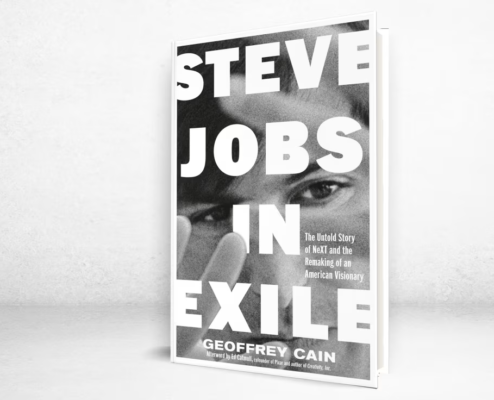
STEVE JOBS IN EXILE: The Untold Story of NeXT and the Remaking of an American Visionary, by Geoffrey Cain. Portfolio, 400 pages.

Twelve years in the wilderness: In Steve Jobs in Exile, Geoffrey Cain delves into the quest undertaken by Apple Computer’s boy wonder as he tries to build his next venture, NeXT Inc. It’s not an untold story, the book’s subtitle notwithstanding, but it certainly hasn’t received the attention it gets here. And while it comes with a happy ending, the route it takes is both tortuous and fascinating.
The years in question stretch from 1985, when Jobs was fired from Apple after repeated run-ins with John Sculley—the Pepsi-Cola Co. president he had chosen to head the company—to 1997, when Jobs ended up back at Apple, hailed as a savior after the professional managers who’d taken over the company drove it to the verge of bankruptcy.
Yet Apple and NeXT had been on weirdly parallel paths. Even as Apple was nearing collapse, NeXT was desperately trying to dig itself out of the many holes that Jobs had dug for it. Jobs may have been a leading preacher of Silicon Valley’s gospel of failure as a steppingstone to success, but his own self-indulgence nearly turned NeXT into a trek to nowhere.
Overspending, indecision, poor judgment and general pigheadedness were characteristic at NeXT from the start. Having pledged $7 million in seed money to launch his new company, Jobs started by paying Paul Rand, the legendary graphic designer, $100,000 to create a company logo. But at least the logo worked. Not so the computer, which Jobs decreed had to take the form of a perfect cube made of magnesium-alloy—never mind that cubes are notoriously difficult to manufacture and magnesium tends to cause paint to bubble. H. Ross Perot, the idiosyncratic billionaire and future presidential candidate, was sufficiently enthralled by Jobs’s charisma to invest $20 million—and to stick around even after he learned that there was no way the NeXT machine would be ready to ship on schedule.

Books: Digital Life

Zeros and ones and the world they create.

Bringing It All Back Home

Steve Jobs in Exile, by Geoffrey Cain

The Wall Street Journal  |  May 17, 2026

Against the Stream

Mood Machine, by Liz Pelly

The Wall Street Journal  |  Jan. 26, 2025

Learning to Live With AI

Co-intelligence, by Ethan Mollick

The Wall Street Journal  |  April 3, 2024

Swept Away by the Stream

Binge Times, by Dade Hayes and Dawn Chmielewski

The Wall Street Journal  |  April 22, 2022

After the Disruption

System Error, by Rob Reich, Mehran Sahami and Jeremy Weinstein

The Wall Street Journal  |  Sept. 23, 2021

The New Big Brother

The Age of Surveillance Capitalism, by Shoshana Zuboff

The Wall Street Journal  |  Jan. 14, 2019

The Promise of Virtual Reality

Dawn of the New Everything, by Jaron Lanier; Experience on Demand, by Jeremy Bailenson

The Wall Street Journal  |  Feb. 6, 2018

When Machines Run Amok

Life 3.0, by Max Tegmark

The Wall Street Journal  |  Aug. 29, 2017

The World’s Hottest Gadget

The One Device, by Brian Merchant

The Wall Street Journal  |  June 30, 2017

Soft Skills and Hard Problems

The Fuzzy and the Techie, by Scott Hartley; Sensemaking, by Christian Madsbjerg

The Wall Street Journal  |  May 27, 2017

We’re All Cord Cutters Now

Streaming, Sharing, Stealing, by Michael D. Smith and Rahul Telang

The Wall Street Journal  |  Sept. 7, 2016

Augmented Urban Reality

The City of Tomorrow, by Carlo Ratti and Matthew Claudel

The New Yorker  |  July 29, 2016

Word Travels Fast

Writing on the Wall, by Tom Standage

The New York Times Book Review | Nov. 3, 2013
Jobs kept making revisions—to the computer chips, the circuit boards, the operating system—and each revision had repercussions. Managers hired to run the perfectly designed factory that Jobs was constructing couldn’t respond to the changes quickly enough, so they were fired, one after another. If something went awry, as things generally did, Jobs would find a scapegoat to eviscerate, preferably in front of everyone else. NeXT fell even further behind schedule. “Steve’s pursuit of perfection was devouring the timeline,” Mr. Cain writes.
Meanwhile, IBM agreed to join forces with Jobs in a partnership that promised $60 million for the operating system NeXT had finally succeeded in developing, plus hefty royalties on every computer IBM could sell that ran it. Then Jobs remembered that he hated IBM. He skipped a crucial meeting; the partnership blew up not long after. Jobs also realized he didn’t want to sell computers to the government, which was the whole point of Perot’s involvement. Perot pulled out.
Canon had somehow been convinced to invest $100 million, but with IBM and Perot out, the Japanese company was, as Mr. Cain puts it, “the last major investor standing.” By this time NeXT had burned through most of its funding and was staring at insolvency, so Jobs flew to Tokyo and asked for more money. Canon ended up giving him another $40 million lest the previous $100 million be lost in bankruptcy. When dealing with Jobs, the sunk cost fallacy was no fallacy at all.
Mr. Cain, a journalist whose previous books include Samsung Rising (2020), unspools this yarn with flair. In his telling, every meeting packs a punchline, conclusions are never foregone and suspense is rarely more than a page or two away. Will Jobs waste yet another opportunity? Will his charisma ultimately dissipate in the face of his many false starts and unfulfilled promises? Will he actually pull off the latest smoke-and-mirrors product demonstration? Will the robots in his specially built factory ever line up at precisely the right angle? Will somebody—anybody—buy a NeXT machine?
If the fiascos Jobs encountered were largely of his own making, the successes often had to do with luck. Chief among them: Apple’s near-bankruptcy in 1996. This was the key to Jobs’s triumphant return.
After years of trying, NeXT had succeeded in building something that was not only innovative but worked. Not the hardware—which Jobs reluctantly abandoned because it cost too much and nobody wanted it—but the operating system, which proved to be as revolutionary as Jobs always claimed it would be. At a time when Microsoft’s Windows was little more than a poorly executed rehash of the original Macintosh OS, NeXT offered full color, advanced sound and graphics, and a programming environment that allowed developers to build applications quickly and easily.
Apple, by contrast, had devolved into a catch-all bin of ill-conceived product offerings driven by obsolete software. It needed a miracle—and that’s what NeXT and its software promised. So Apple’s then-CEO, Gil Amelio, bought NeXT and got Jobs along with it. Jobs repeatedly proclaimed that he didn’t want to run Apple. It’s a sign of Apple’s desperation that he was then able to execute a reverse takeover that ended with him firing most of its board, naming his own board, and then being named interim CEO. For Apple, as for Jobs, the whole episode involved the kind of deus ex machina you could never get away with in fiction.
Mr. Cain convincingly proves his central thesis: that Jobs’s years at NeXT were the crucible that transformed him from willful brat to seasoned leader. The genius needed chastening, and in Steve Jobs in Exile you can witness it happening, sometimes day by day. The transition wasn’t complete: Jobs was still strong-willed, but now his actions were intentional rather than hot-blooded. When he at last decides to call off the “holy war” he’d long waged against Microsoft and persuade its CEO, Bill Gates, to help keep Apple afloat, Mr. Cain tells us, Jobs finally understands something he never had before: “Righteous indignation doesn’t pay bills.”
People may conclude that Steve Jobs in Exile is a business book, but it’s more than that. What Mr. Cain has created is a study in individual magnetism and group dynamics: how humans master their emotions and tame their demons and learn to work together—or don’t. ◆

Among Frank Rose’s books are West of Eden: The End of Innocence at Apple Computer, an account of the Steve Jobs-John Sculley era at Apple.

More Essays